
Know what you are buying before you buy it.
Funds, markets and the accounts underneath them, taught from live factsheets and real screens rather than from a glossary. This is where your surplus money goes to work, so it is worth understanding properly.
The fund page, read line by line.
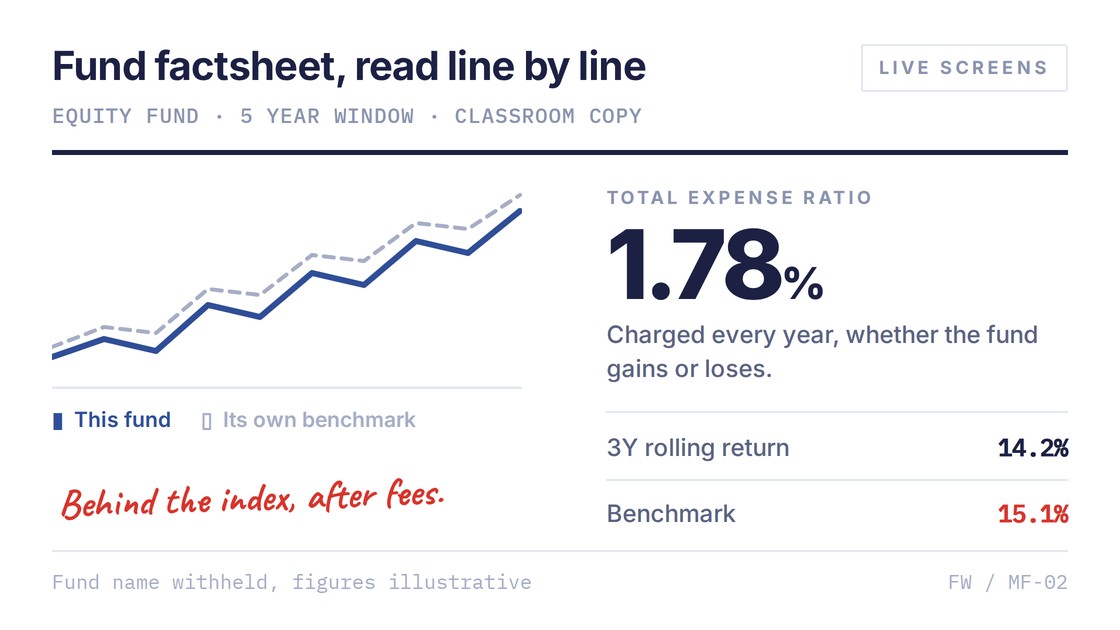
Expense ratio, rolling return, benchmark, exit load. We put a live factsheet on the table and take it apart, because the page your distributor skips is the page that decides your return.
Real documents on the table. That is the whole method.
Is this the right room for you?
Final-year students (UG and PG), working professionals and business owners who are investing already, or about to, and would rather not learn by losing.
If you hold funds you have never read
We open a live factsheet and take it apart line by line. By the end you can tell whether the fund you own is doing what you bought it to do.
If you are drawn to trading
We work out your actual risk appetite on paper first, then look at what F&O really costs. The honest answer for most people is uncomfortable, and we give it anyway.
- Investment fundamentals, without the jargon
- Your real trading appetite, measured, not assumed
- Analysing a trend instead of following one
- How to react to a market that has moved against you
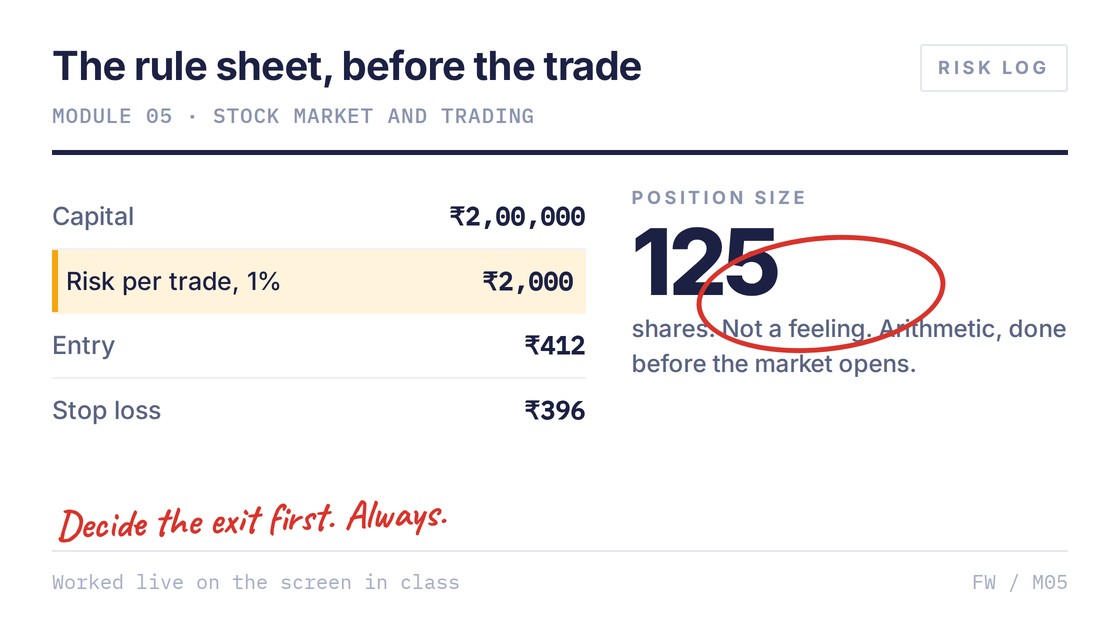
- Risk management as a rule set, not a feeling
- Scams, tip groups and the common expensive mistakes
What it costs, stated up front.
Every fee is inclusive, case materials, both assessments, the certificate, and lunch and coffee on teaching days. No exam fee, no material fee.
Mutual funds, trading and international trades
25 hours · classroom · Finwisdemy certificate
Twenty-five hours across funds, markets and the mechanics of a trading account, ending in the lab with real factsheets and real portfolios.
batch dates and fee confirmed on enquiry
Fees are payable in full at enrolment. Seats are confirmed in the order they are paid, and batches are deliberately small.
How the time is actually spent.
The sessions, and the document on the table for each one.
What a mutual fund actually is
Structure and regulation · equity, debt and hybrid · direct versus regular · expense ratio
A live factsheet, dismantled line by line
SIP, lump sum and the honest comparison
Rupee-cost averaging · goal matching · what compounding needs from you · when a SIP is the wrong answer
Your own goals, costed and dated
Evaluating a fund without a tip
Benchmarks · rolling returns · drawdown · fund manager change · when to exit
Two funds in the same category, ranked with reasons
Demat, trading and the market's plumbing
Opening an account · order types · settlement · charges you did not see
A real contract note, read end to end
Investing versus trading, and F&O
Time horizon · leverage · the arithmetic of options · position sizing · stop discipline
Your own risk appetite, scored on paper
Risk management and the lab
Portfolio construction · rebalancing · international exposure · tips, hype and how they reach you
A portfolio matched to goals you actually have
Six modules. One complete financial journey.
From your first bank account to your first tax return. Each module ends in the Practical Finance Lab, where the concept becomes a calculation you have run yourself.
Mutual funds
- Mutual fund basics
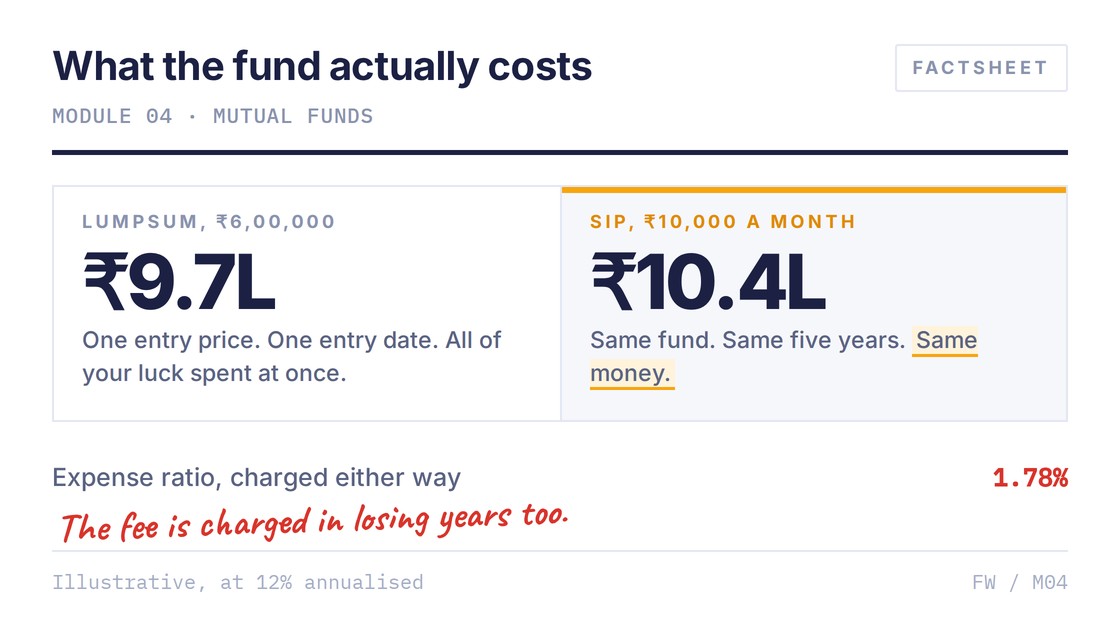
- SIP versus lump sum
- Equity, debt and hybrid funds
- Risk versus return
- Reading a factsheet
- Evaluating a fund
Stock market and trading
- Demat and trading accounts
- Investing versus trading
- F&O and understanding risk
- Reading a stock
- Risk management
- Avoiding tips and hype
Practical Finance Lab
Every module ends with real calculations, reports, policies and case studies. Because knowing is not the same as doing.
Read a real CIBIL report
Each small group gets its own anonymised report. The stack is deep enough that nobody shares. Read it end to end and find the reason the application failed.
Compare two loan offers
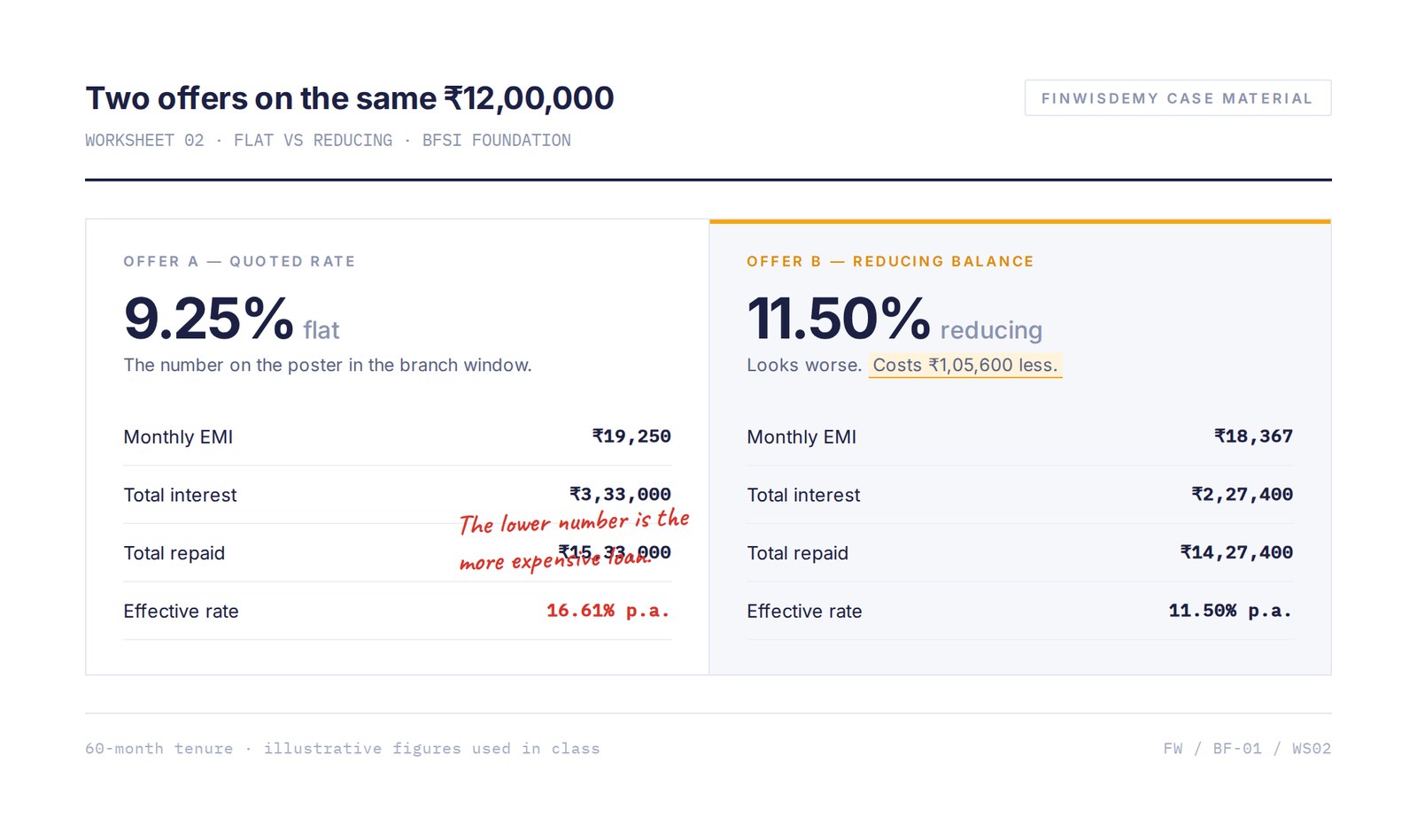
Two real offers, one headline rate each. Apply the three-rule checkpoint: net-worth impact, transparent single-digit APR, EMI under 20% of take-home. Decide which is genuinely cheaper, and why the other looked it.
Cross-examine a policy
Two or three real policy documents. Circle the sub-limits, the co-pay percentage, the room-rent cap and the waiting period. Debrief the ones nobody spotted.
You rotate through all three stations, 15 minutes of work, 5 minutes comparing as a group, 5 minutes of debrief. You take the material home the same day.
The practitioners in this room.
Each session is led by someone who has done this work for a living.
Prashant Jogimutt
Mutual funds · Investment planning · Goal matching
Leads the mutual funds module. Prashant teaches fund selection the way it is done in practice, factsheet open, benchmark alongside, and the question of what the money is actually for asked first.
Prajwal Shetty
Trading accounts · Market mechanics · Risk management
Takes the trading half of Programme 02, how an account actually works, what leverage costs, and why position sizing matters more than any view on the market.
Praveen Balasundar
Financial literacy · Loans and CIBIL · Insurance and protection
Ten years on the front line of lending and insurance before he taught any of it. Praveen designed the Financial Mastery curriculum and teaches the credit and protection modules from files that came off his own desk.
Where this programme leads.
Stated plainly. These are the doors it opens, not promises about walking through them.

Into your own portfolio
Holdings you chose deliberately, matched to dated goals, with a rule for when to sell.
Into a market-facing role
Distribution, advisory, research support and fintech roles that expect this vocabulary on day one.
Into fewer expensive mistakes
The ability to recognise a tip, a hype cycle and a product sold on last year’s return.
A credential that stands out on your resume.
Every learner who completes a programme receives a Finwisdemy Certificate of Completion, recognised proof of practical financial competency you can show in interviews, at placements and on LinkedIn.
Resume
A real, industry-relevant credential.
Something specific to show on your professional profile.
BFSI ready
A practical edge in placements and interviews.
About mutual funds, trading and international trades.
Do I need a background in finance or commerce?
No. Every programme starts from zero and assumes no vocabulary. Students, freshers and working professionals sit in the same room and it works, because we teach from real documents rather than from theory.
What does it cost?
BFSI Basics is ₹3,999 for the day. BFSI Advance is ₹14,999 for the full 6-7 day programme, with limited seats. That fee rises to ₹24,999 for later batches. Founder Mindset is ₹4,999 for the one-day Explorer and ₹14,999 for the three-day Builder. Fees for Mutual Funds and Trading and for Career Ready are confirmed on enquiry. Every fee is inclusive: case materials, both assessments, the certificate, and lunch and coffee on teaching days.
Do you guarantee a job?
No, and we would not trust anyone who does. Every provider promising total job assurance hedges it in their own small print. What we do offer is placement assistance: we hold a working list of BFSI employers who hire at entry level, we match your profile against what they are actually looking for, and we put you forward for interviews you are a genuine fit for. You still have to pass the interview. We prepare you for that with a recorded mock-interview lab and written feedback.
Who teaches?
Practitioners. Finance is led by Praveen Balasundar, ten years in lending and insurance, IRDAI, MDRT, COT and NISM certified. Seven more faculty lead the tracks they have worked in: mutual funds, trading, digital marketing and AI, career coaching, professional image, global education and career opportunities.
Is this online or in a classroom?
Classroom, at Rajajinagar in Bengaluru, with limited seats. The lab work does not survive translation to a webinar, so we do not run one. Closed cohorts run on your campus or at your office.
What is the Practical Finance Lab?
The part of every module where you stop listening and start working. Real anonymised CIBIL reports, real loan offers compared side by side, real policy documents cross-examined for sub-limits. Three stations, fifteen minutes each, then a debrief.
Can you run this for our college or company?
Yes. Every programme runs as a closed cohort on campus or on site, with results reported back at cohort level. Colleges usually want awareness of the scams currently targeting students alongside the core material; employers usually want the debt-trap and investment-strategy sessions weighted heavier. Tell us the group and we will build it around them.
Come and sit in the room.
Tell us which programme interests you and we will call you the same working day. One call. Then it is your decision.
support@finwisdemy.com
No. 150, Ground Floor, 19th Main
Rajajinagar 2nd Block, Bengaluru 560010, Karnataka
Request a call back
One call. No sequence of emails, no sales pressure.