
Four decisions that cost real money.
Anonymised, used with permission, and handed to you exactly as they arrived. Read them here, then come and work the file in the room, where you get the documents before you get the answer.
Four decisions that cost real money.
Every one of these came off a practitioner’s desk. Names and identifying detail are removed; the numbers and the documents are not. In class you get the file before you get the answer.
The ₹85,000 EMI problem
How several perfectly reasonable EMIs destroyed one month’s cash flow.
A salaried professional with a comfortable income and no single expensive loan. A car loan. A personal loan taken during a family emergency. A consumer-durable EMI on a phone. Two card balances being serviced at minimum due. Every one of them approved, every one of them affordable on the day it was signed.
Nobody had ever added them up. Together the outflow reached ₹85,000 a month, well past the point where anything is left for saving, and past the point where a lender will look at the file kindly. Salary landed and was gone inside a fortnight, so the next shortfall was met with another small loan.
This is the debt trap in its ordinary form: no reckless decision anywhere, just an EMI-to-take-home ratio nobody was tracking. Each loan in isolation passed the test. The stack never did.
The rule we teach: total EMI stays under 20% of net take-home, and you check the total, never the individual loan. In the lab you map your own outflows on one sheet. Most people have never seen them together, and the sheet is the intervention.
Good CIBIL. Loan rejected. Why?
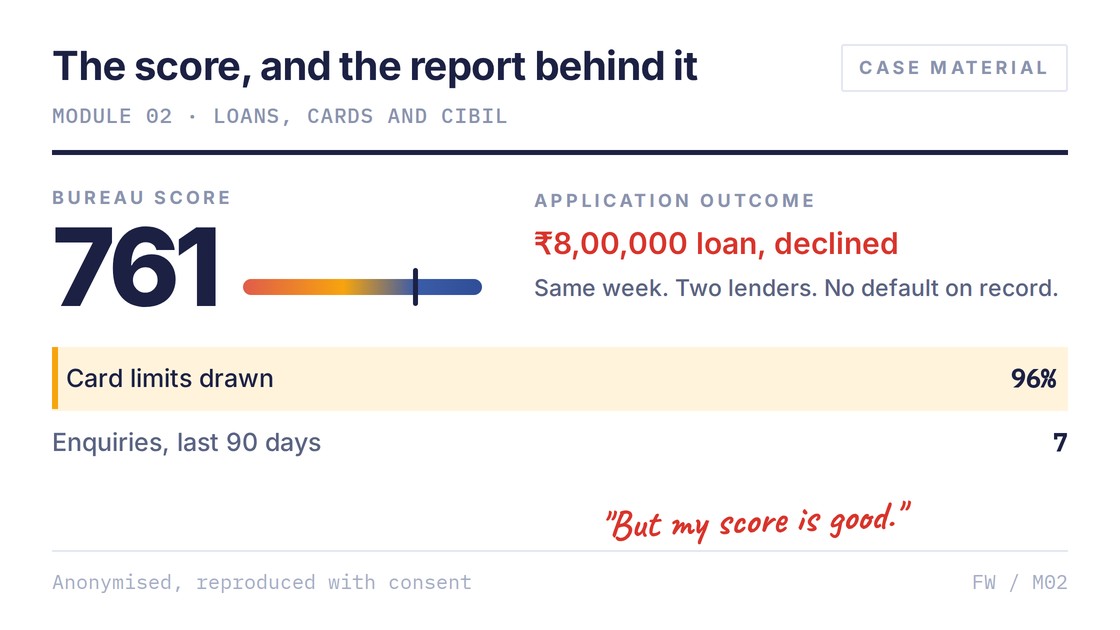
A score in the prime band, declined twice in the same week.
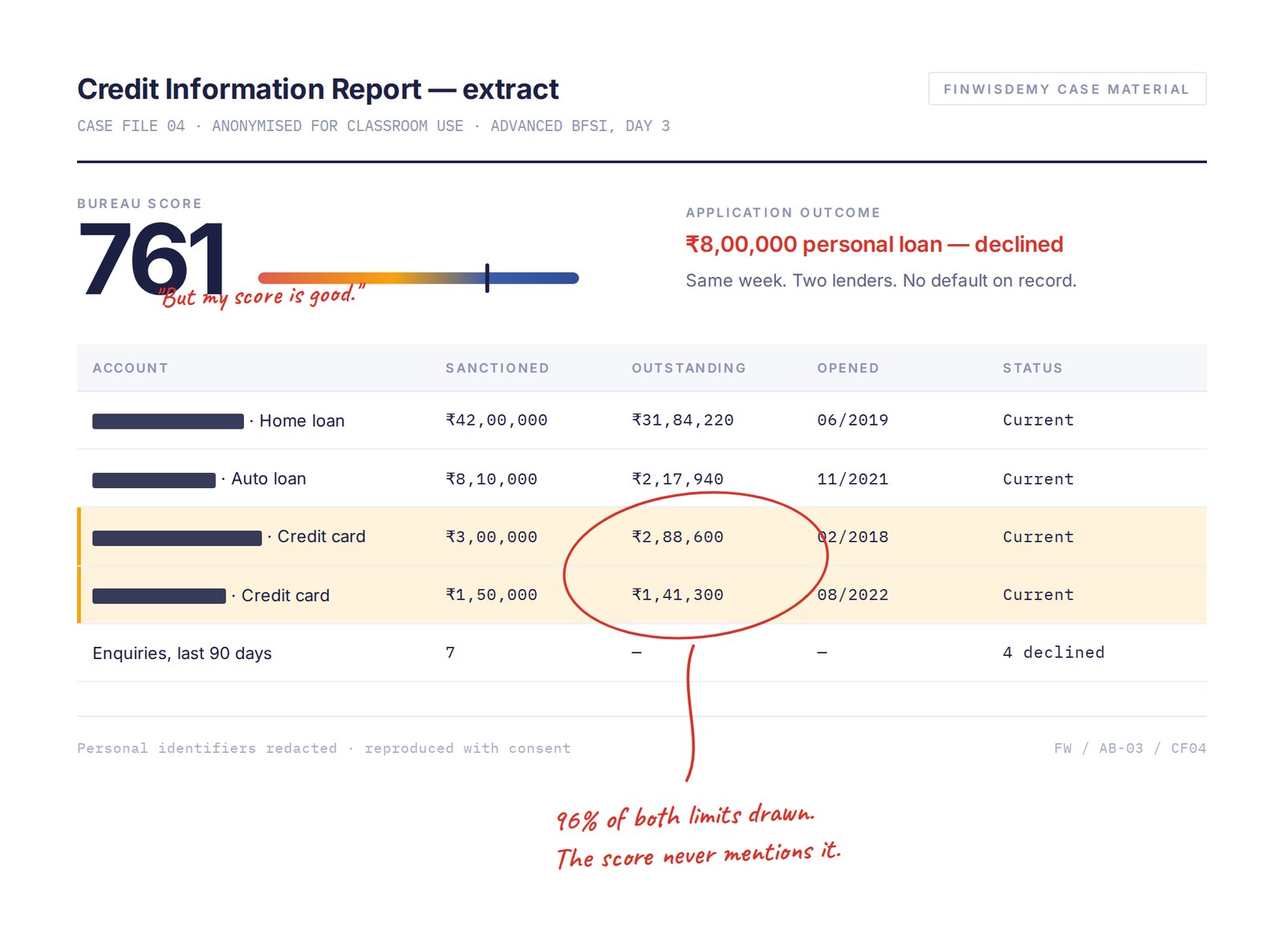
An applicant with a score comfortably inside the 750-900 prime band, applying for a personal loan at two lenders. Both declined. Neither decline letter named a reason a normal person could act on.
The score is a summary, not the file. Lenders read the report underneath it, and the report showed credit utilisation sitting above 70% of the available limit, a run of fresh enquiries from the previous eight weeks, and a weak average bank balance in the months before the application.
Utilisation alone carries 30% of the score’s weight, and above 70% it reads as dependence rather than discipline. Enquiry clustering reads as shopping in distress. Neither had dented the headline number yet, but both were visible to a human underwriter, and to the automated screen ahead of them.
We teach the report, not the score: payment history 35%, utilisation 30%, credit mix 20%, duration 15%, plus the things beyond the score entirely. In the lab you read a real anonymised report end to end and find the decline reason yourself before we confirm it.
Insurance was there. The claim wasn't fully paid.
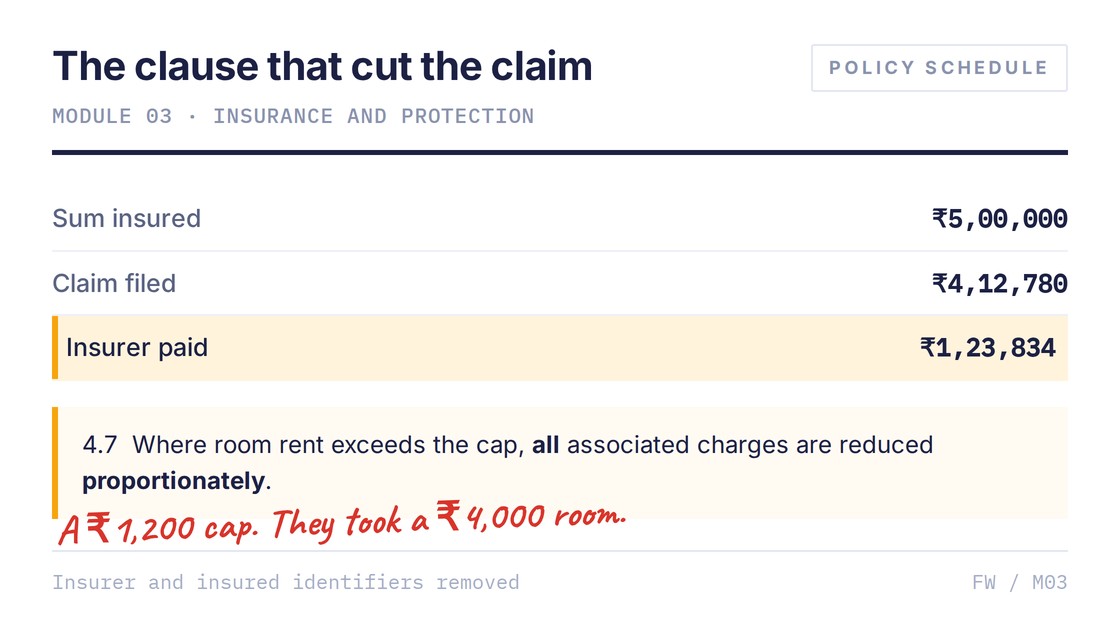
A valid policy, a genuine hospitalisation, and a settlement well below the bill.
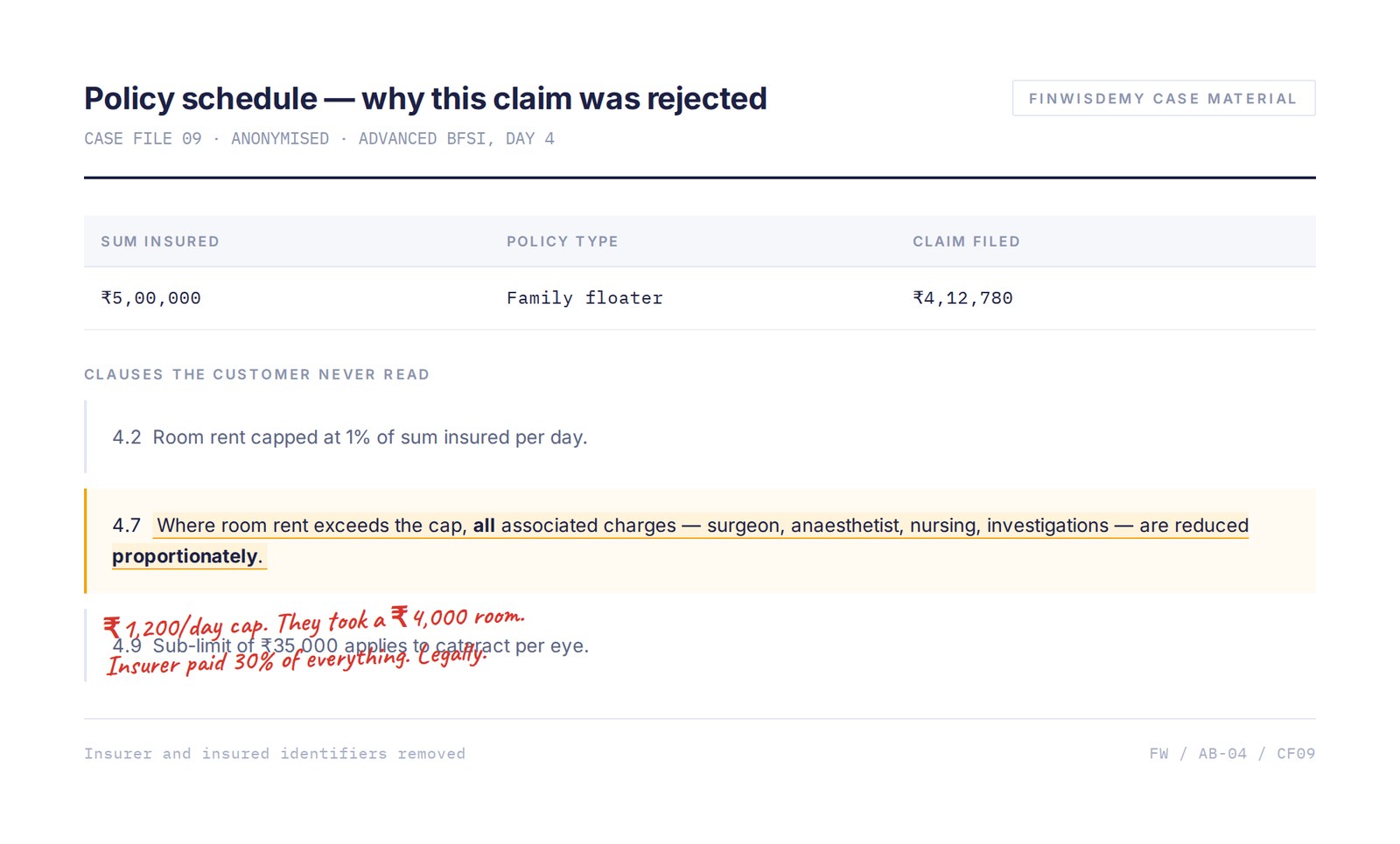
A family with health cover in force, premiums paid on time, hospitalised for a planned procedure. The policy was real and the claim was admitted, which is where most people assume the story ends.
The settlement came in far short of the bill. A room-rent sub-limit had been breached, and because the room category was higher than the policy allowed, an entire proportional deduction was applied across the associated charges, not only the room. A co-pay clause took a further slice. Neither clause was hidden. Neither had ever been read.
Claims are rarely refused outright. They are reduced by sub-limits, co-pay percentages, waiting periods on pre-existing conditions, and by material non-disclosure at the application stage. A blank or outdated nominee field does its own damage later.
In the lab each pair takes a real policy prospectus and circles the sub-limits, the co-pay, the room-rent cap and the waiting period. We then debrief the ones nobody spotted. It takes twenty minutes and it is the highest-value twenty minutes in the programme.
One wrong loan decision cost ₹1 lakh+ extra.
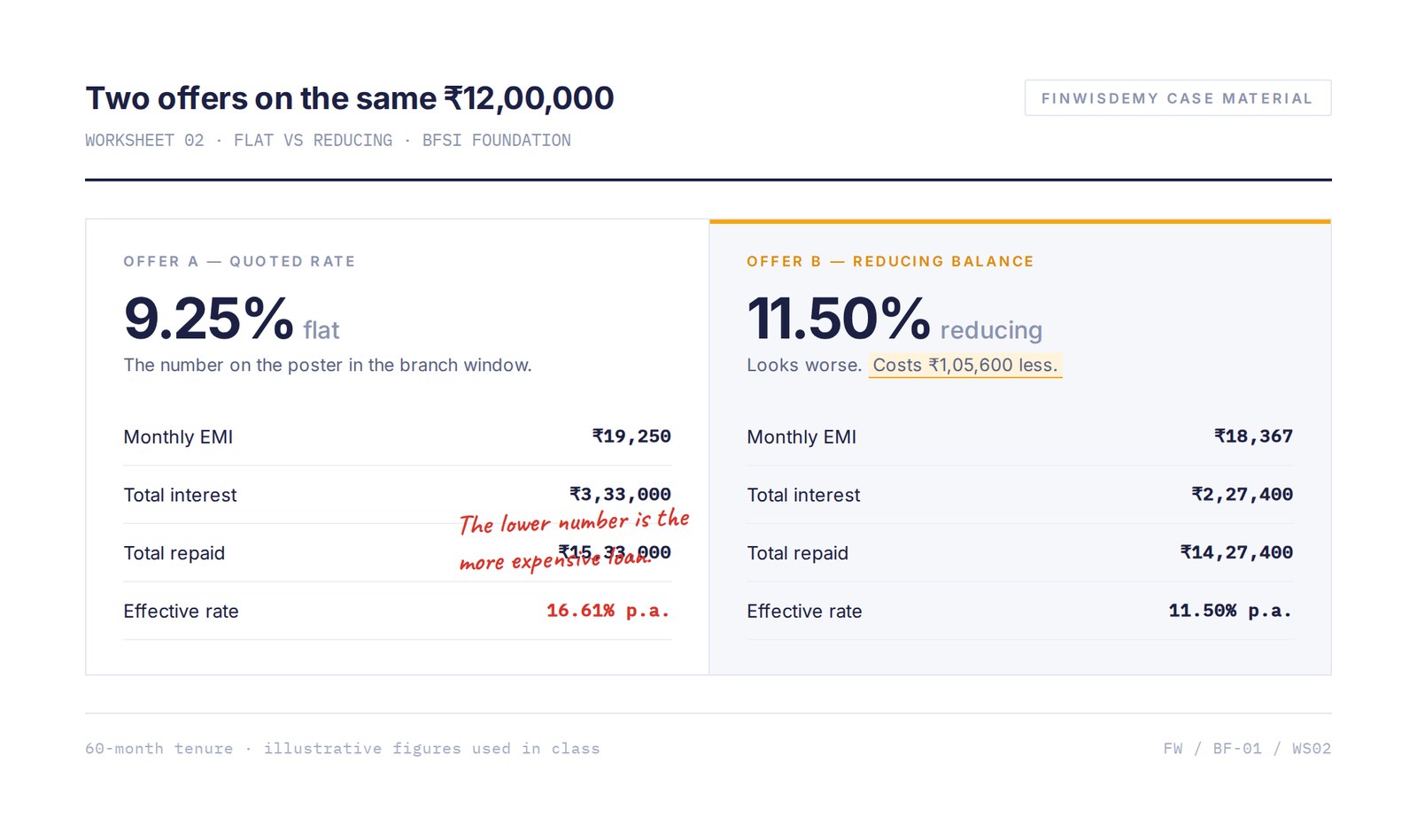
Two offers on the same amount. The one advertising the lower rate was dearer.

Two sanction letters for the same borrowing, from two lenders. One quoted a visibly lower headline rate and a smaller monthly EMI over a longer tenure. It was the obvious choice, and it was chosen.
The lower headline was a flat rate, charged on the full original principal for the entire tenure, whether or not you have repaid most of it. The other was reducing balance, charged only on what remains outstanding. On the same amount, the flat offer cost more than ₹1,00,000 extra over the life of the loan.
Tenure compounds the error. On a ₹50,000 loan at 10%, five years costs ₹13,741 in interest and fifteen years costs ₹46,714, almost three and a half times as much, for the comfort of a smaller monthly figure. The smaller EMI is what people compare, and it is the wrong number.
The three-rule checkpoint before you sign: does this raise my net worth or earning potential; is the APR transparent, single-digit and free of hidden processing charges; does the EMI stay under 20% of my net take-home. In the lab you run both offers on the live calculator and watch the rupee gap appear.
These four run in the Practical Finance Lab. You work the file in a small group, reach a verdict, and then we show you what actually happened.
Six modules. One complete financial journey.
From your first bank account to your first tax return. Each module ends in the Practical Finance Lab, where the concept becomes a calculation you have run yourself.
Financial foundation
- Banking and KYC basics
- Active versus passive income
- Needs versus wants
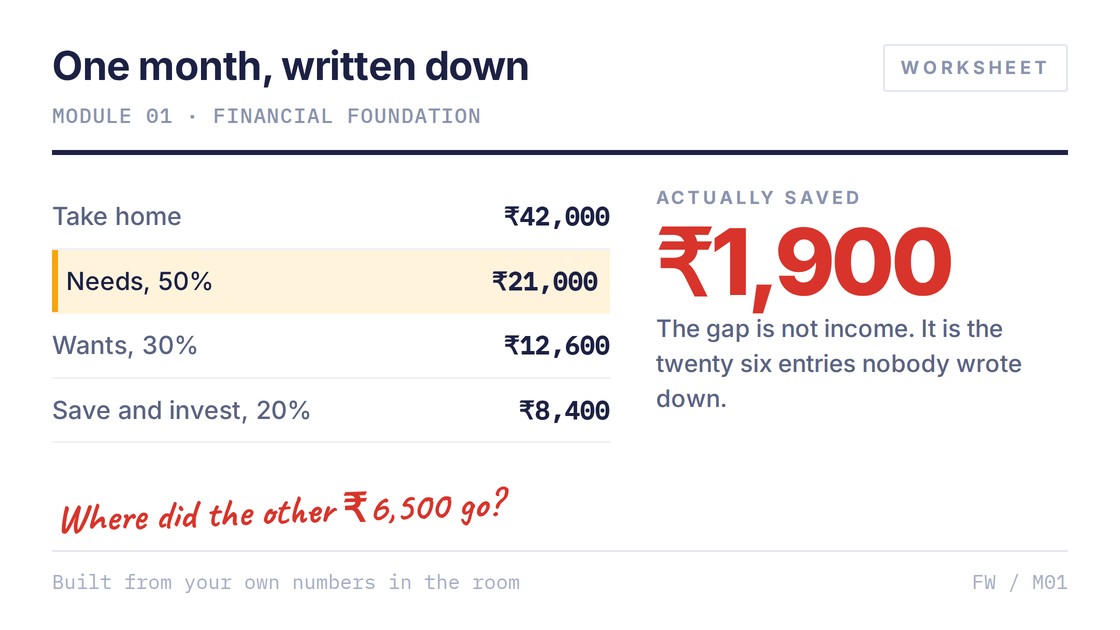
- Budgeting and the 50/30/20 rule
- Saving and financial planning
- Smart money habits
Loans, credit cards and CIBIL
- Home, personal and business loans
- Education, car and gold loans
- Credit cards and the billing cycle
- EMI, interest and tenure
- CIBIL score and the credit report
- The minimum-due trap
Insurance and protection
- Life and term insurance
- Health insurance
- Motor and general insurance
- Insurance versus investment
- Human life value
- Claims and fraud awareness
Mutual funds
- Mutual fund basics
- SIP versus lump sum
- Equity, debt and hybrid funds
- Risk versus return
- Reading a factsheet
- Evaluating a fund
Stock market and trading
- Demat and trading accounts
- Investing versus trading
- F&O and understanding risk
- Reading a stock
- Risk management
- Avoiding tips and hype
Taxation
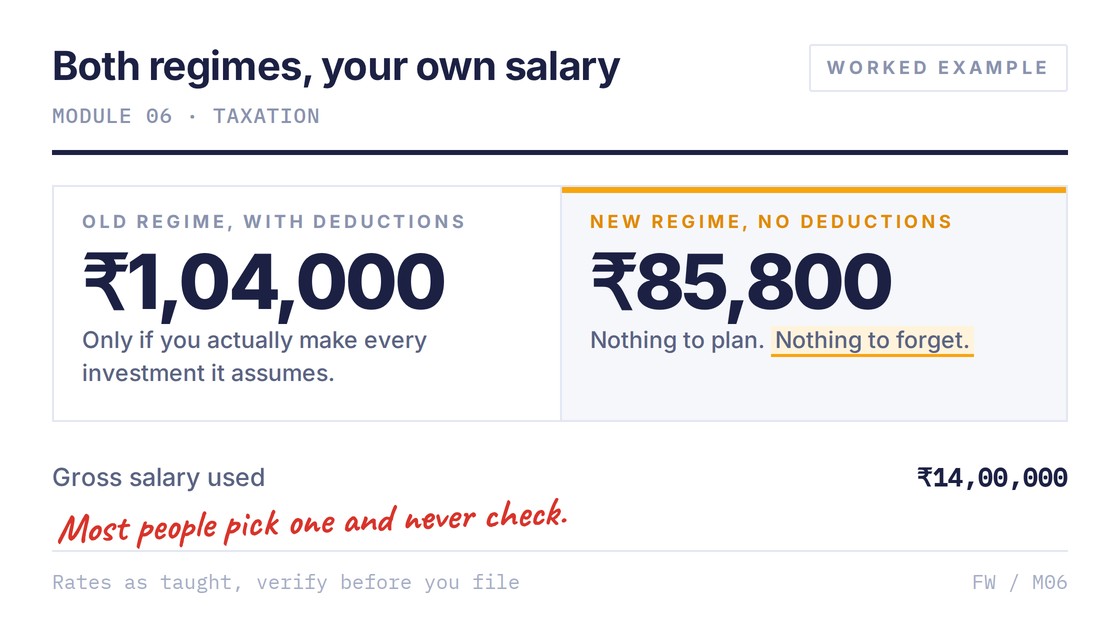
- Old versus new tax regime
- Salary, TDS and Form 16
- 80C and tax-saving options
- ELSS and PPF
- Capital gains
- ITR basics and planning
Practical Finance Lab
Every module ends with real calculations, reports, policies and case studies. Because knowing is not the same as doing.
Read a real CIBIL report
Each small group gets its own anonymised report. The stack is deep enough that nobody shares. Read it end to end and find the reason the application failed.
Compare two loan offers
Two real offers, one headline rate each. Apply the three-rule checkpoint: net-worth impact, transparent single-digit APR, EMI under 20% of take-home. Decide which is genuinely cheaper, and why the other looked it.
Cross-examine a policy
Two or three real policy documents. Circle the sub-limits, the co-pay percentage, the room-rent cap and the waiting period. Debrief the ones nobody spotted.
You rotate through all three stations, 15 minutes of work, 5 minutes comparing as a group, 5 minutes of debrief. You take the material home the same day.
About the case work.
What is the Practical Finance Lab?
The part of every module where you stop listening and start working. Real anonymised CIBIL reports, real loan offers compared side by side, real policy documents cross-examined for sub-limits. Three stations, fifteen minutes each, then a debrief.
Do I need a background in finance or commerce?
No. Every programme starts from zero and assumes no vocabulary. Students, freshers and working professionals sit in the same room and it works, because we teach from real documents rather than from theory.
Is this online or in a classroom?
Classroom, at Rajajinagar in Bengaluru, with limited seats. The lab work does not survive translation to a webinar, so we do not run one. Closed cohorts run on your campus or at your office.
Can you run this for our college or company?
Yes. Every programme runs as a closed cohort on campus or on site, with results reported back at cohort level. Colleges usually want awareness of the scams currently targeting students alongside the core material; employers usually want the debt-trap and investment-strategy sessions weighted heavier. Tell us the group and we will build it around them.
Come and sit in the room.
Tell us which programme interests you and we will call you the same working day. One call. Then it is your decision.
support@finwisdemy.com
No. 150, Ground Floor, 19th Main
Rajajinagar 2nd Block, Bengaluru 560010, Karnataka
Request a call back
One call. No sequence of emails, no sales pressure.